The Story of India's Oldest 'ZERO' // '0' Inscription at Gwalior

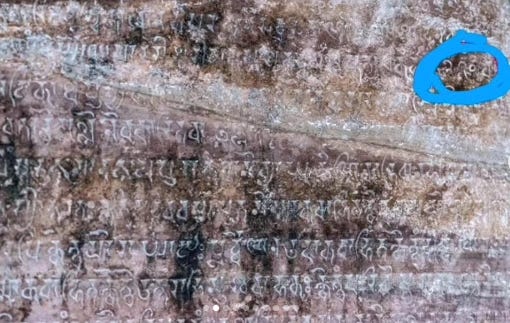
An inscription on a temple wall in Gwalior, India, dates back to the ninth century, and has been considered the oldest recorded example of a zero. This is that temple, the Chaturbhuj Temple. Or is the oldest Zero existing in today's Pakistan, or is it in Cambodia? Let's unravel...
Zero as a placeholder was invented independently in civilizations around the world, according to Annette van der Hoek, an Indologist. The Babylonians got their number system from the Sumerians, the first people in the world to develop a counting system. Developed 4,000 to 5,000 years ago, the Sumerian system was positional.
Robert Kaplan, author of "The Nothing That Is: A Natural History of Zero," suggests that an ancestor to the placeholder zero may have been a pair of angled wedges used to represent an empty number column. However, Charles Seife, author of "Zero: The Biography of a Dangerous Idea," disagrees that the wedges represented a placeholder. The Sumerians' system passed through the Akkadian Empire to the Babylonians around 300 B.C. There, Kaplan agrees, a symbol appeared that was clearly a placeholder. Initially, the Babylonians left an empty space in their cuneiform number system, but when that became confusing, they added a symbol, double angled wedges to represent the empty column.
The Mayans developed zero as a placeholder around A.D. 350 and used it to denote a placeholder in their elaborate calendar system. The Chinese meanwhile used the concept of a blank to denote the idea of a Zero.
The mathematical zero ('shunya', in Sanskrit) may have arisen from the contemporaneous philosophy of emptiness or Shunyata. The concept, "shunya", which meant "void" or "empty" derived from the word for growth, combined with the early definition found in the Rig-veda of "lack" or "deficiency." The derivative of the two definitions is Shunyata, a Buddhist doctrine of "emptiness," or emptying one's mind from impressions and thoughts. This builds the bridge between Indian philosophical concepts and mathematics. Zero and its operation are first defined by [Hindu astronomer Brahmagupta in 628. He developed a symbol for zero: a dot underneath numbers. But he, too, does not claim to have invented zero, which presumably must have been around for some time. The plot only thickens on the way back to look for Zero, but it nevertheless appears that Brahmagupta's symbolic representation is what has ironically given a sense of everything to nothing as regards Zero or Shunyata.
But what about the inscription in Gwalior then? Until quite recently, it was believed that this was the oldest recorded Zero in the world, when a startling discovery from Cambodia relegated Gwalior to the second position. The French archaeologist Georges Coedes deciphered a plaque known as inscription K-127 found in the ruins of a 7th century temple at Sambhor in Cambodia as predating the Gwalior inscription by almost 200 years. The Khmer Inscription K-127 was made in AD 683, is that it indicates that at present knowledge, the first zero is an ancient Khmer invention, while the first known use of a numerical zero in India was dated to the mid-ninth century, an era that coincided with the Arab Caliphate. But Gwalior suffered a further relegation with the discovery of the Bakhshali manuscript. The Bakhshali manuscript was discovered in 1881, buried in a field in what was then an Indian village called Bakhshali, now in Pakistan. It was broadly recognised as the oldest Indian mathematical text, but it’s exact age had been widely contested. Written on 70 fragile leaves of birch bark, recent radiocarbon dating of the manuscript has placed its date to the 3rd century AD, predating the Gwalior zero inscription by 500 years. In a scholarly paper The Bakhshali Manuscript: A Response to the Bodleian Library’s Radiocarbon Dating by Kim Plofker et. al. questions are raised as to whether the text written on the bark is contemporary with the radiocarbon date for the bark itself.
Now, to the temple. Half way on the eastern approach to the Gwalior Fort stands the rock-hewn Chaturbhuj Temple, possibly the oldest monument on the Fort. Dedicated to Vishnu, the temple consists of a square shrine with a spire on it, and a portico in front resting on pillars. The upper portion of the spire was damaged and is now restored with plain blocks of stone. There are ample examples of beautiful sculptural art on its jangha wall, including figures of dancing Ganesha, Kartikeya, Parvati in Panchagni-tapa, Navagrihas, Vishnu, Astadikapalas etc.
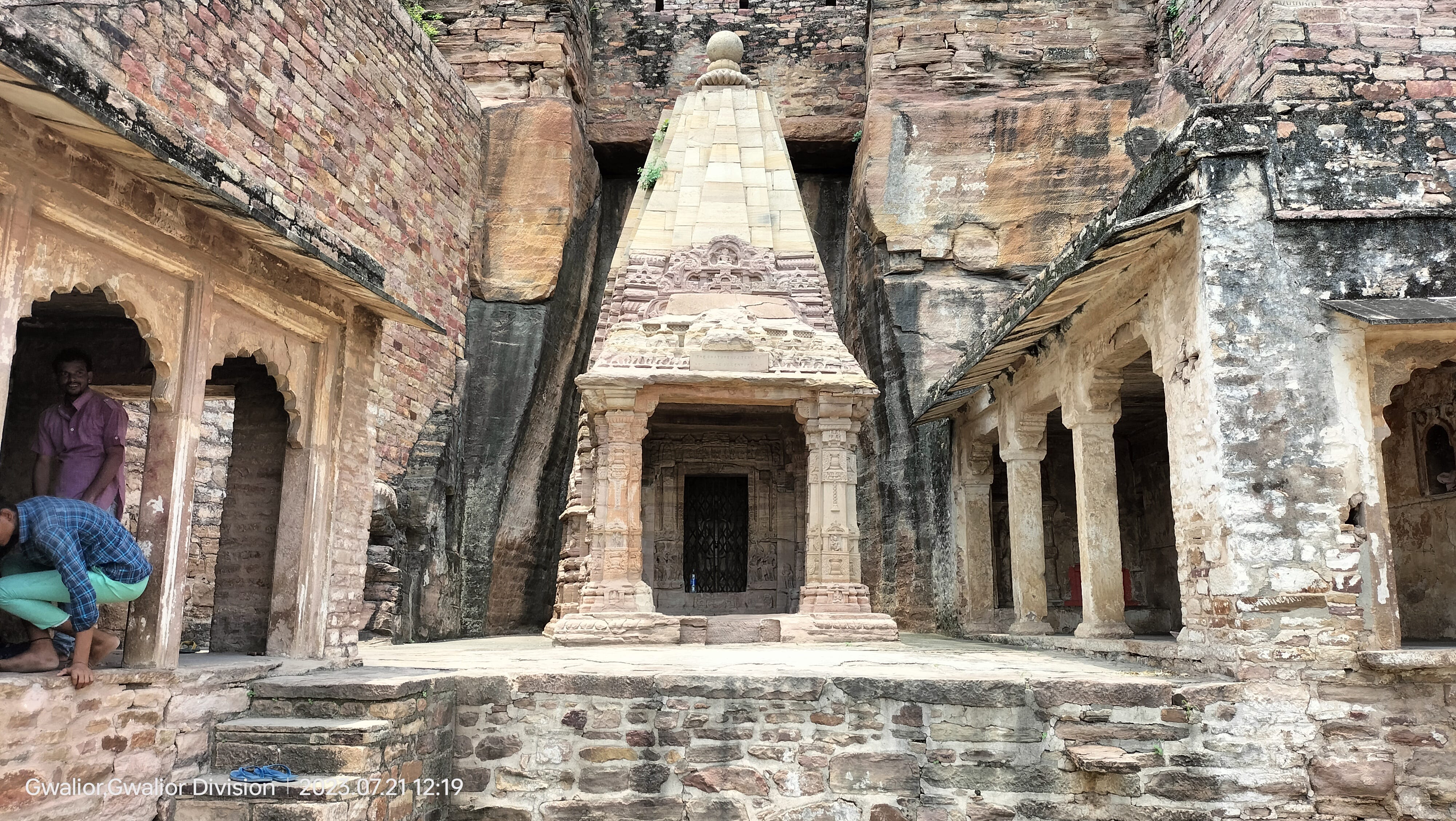
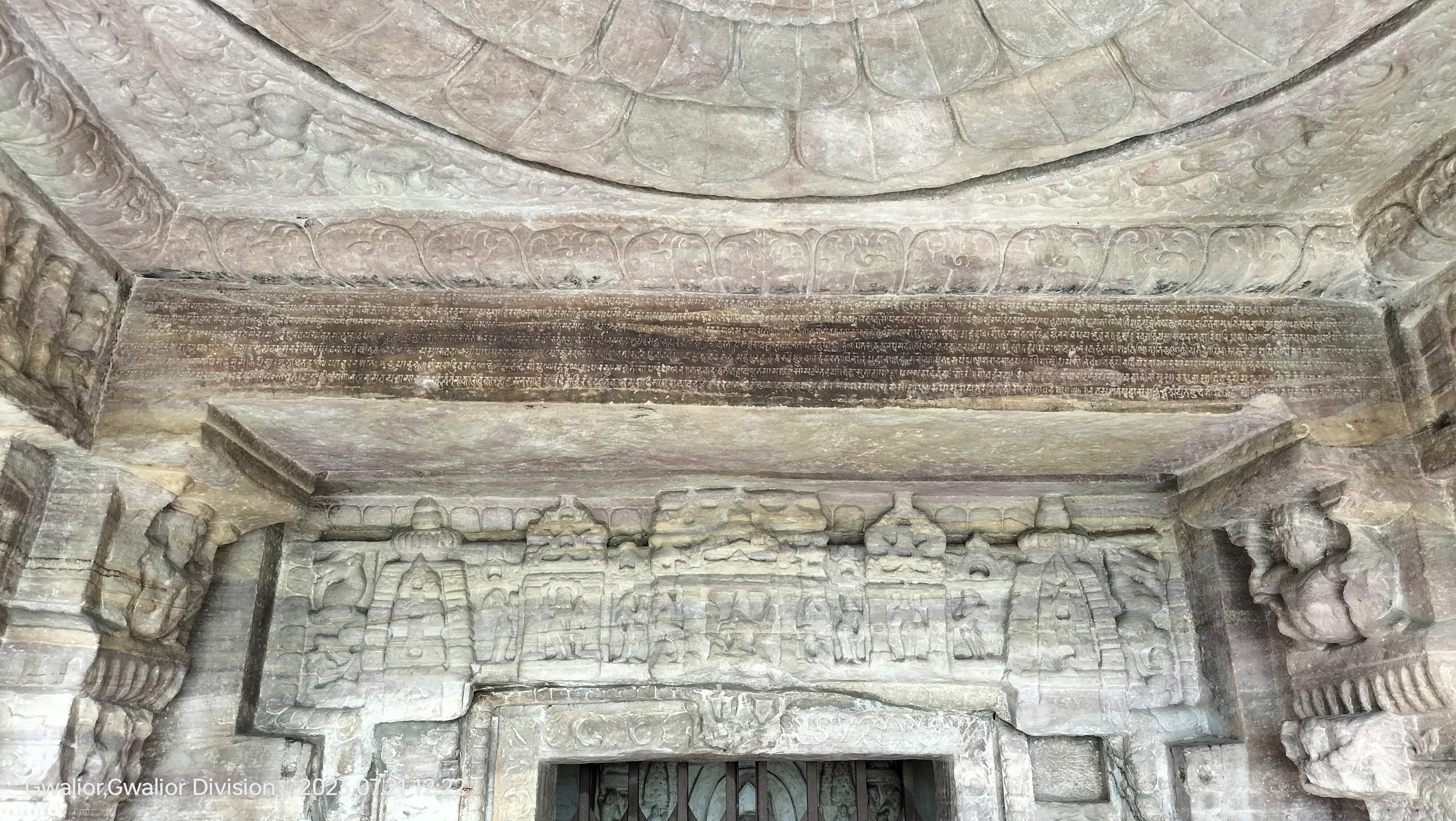
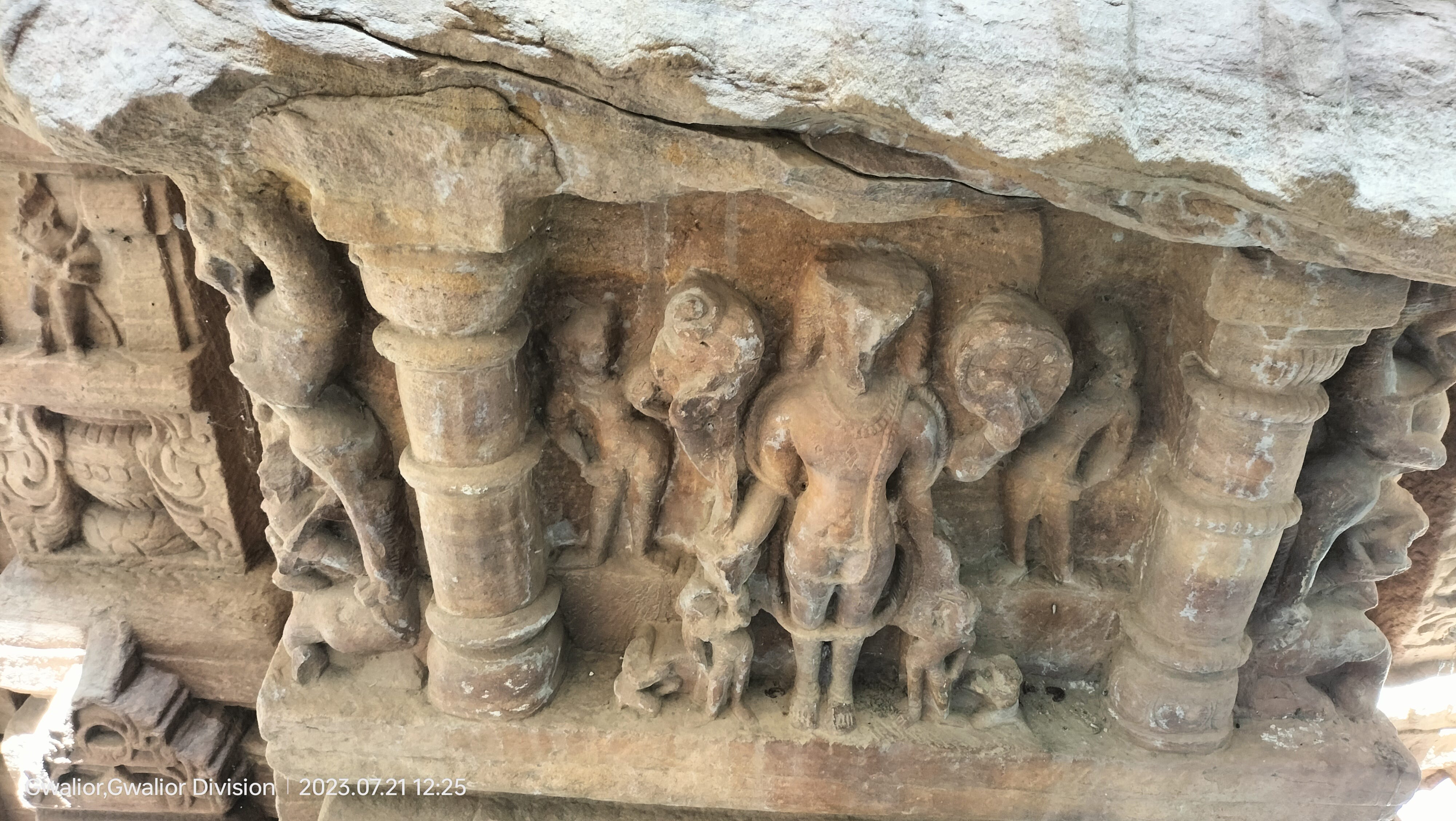
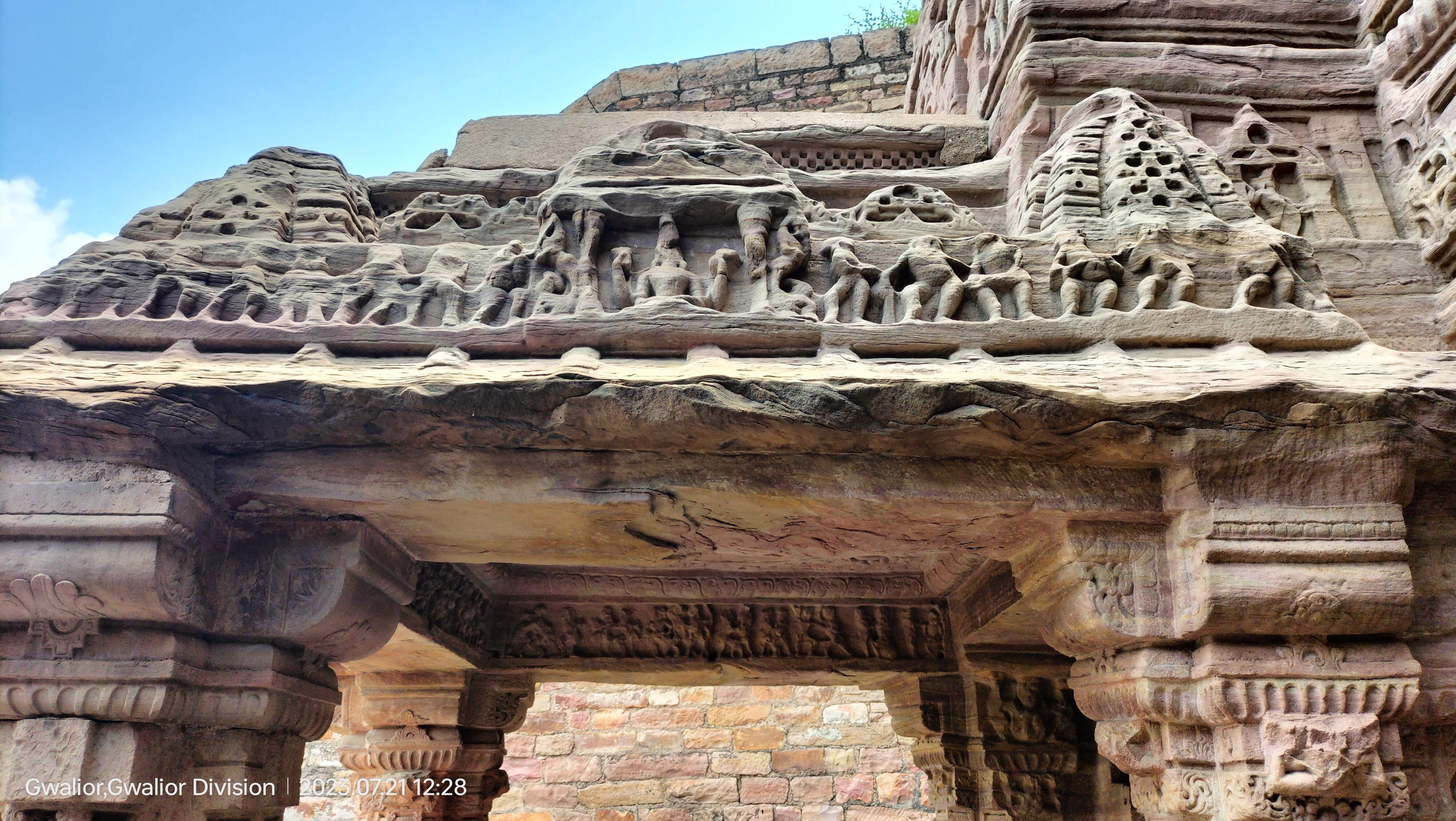
The Detail - According to the inscription in 7 lines on the lintel of the Temple, the temple was cut from the rock by one Alla, an official of the Gurjara-Pratiharas under Mihir Bhoj in 875-76 CE. Seated lions, also carved out of the rock, once flanked the temple, but were destroyed by later renovations. The smooth upper section, however, has only been restored in the 20th century. On plan, there are three receding faces (anga) with an open porch resting on pillars before the entrance. The low plinth consists of a single slab and a lotus molding. On the plinth rests the vedibandha. The compression of the moldings have been inspired from the temples at Bateshwar. The vedibandha here is the first record of appliqué niches in the region. The wall section has rathika niches that cover the entire section. In the main niches are figures of Varaha, Vishnu and Trivikarma. The guardians of the directions appear on the corners, while awnings shelter the battered images. The pratiratha (subsidiary offset) is taken up by a pilaster with an appliqué niche. The pediments at this temple are squat and they traverse a triangular shape on the central projections. The entablature is marked off from the wall by a narrow recess and is made up of two cornices and a row of dentils, or nivrapattika.
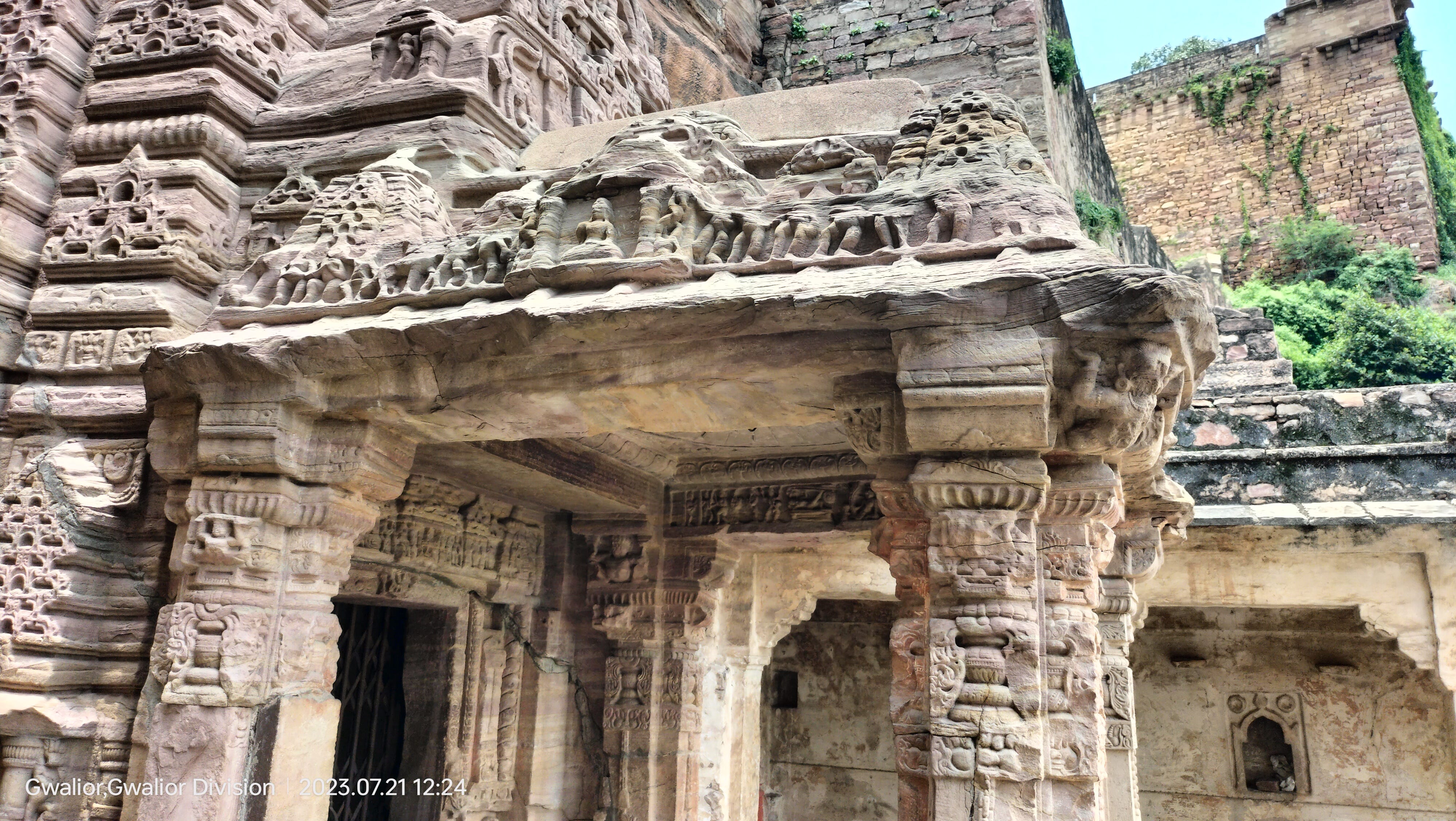
The upper reaches of the temple differ from the lower, and the most obvious difference is the elimination of the double venukosa (spire corners) replaced by a lattice. The vertical crevices are reduced to narrow slits with less plastically carved discs. When compared with other older shrines in the region of the Fort, we find that the bold single arch crowning the sukanasa is replaced by an intricate pattern of wavy lines. The porch before the entrance has four cruciform pillars, each set on a molded base. These pillars have overflowing pots and small rathika niches containing figurines and diamond-shaped lozenges. From the mouths of the grotesques come chains with bells on the end. A complex abacus, capital and bracket rest on top. On the inside edge of the lintels of the porch are damaged reliefs showing scenes from Krishna’s life. Externally, the porch roof is also damaged, but there are traces of several horizontal tiers, each separated by a recess carrying a checker pattern. The door of the temple is the first dated example in the Gwalior region. The over-door or uttaranga is decorated with rampant lions, rathika niches and temple models. This section is elaborate and rich in carvings.
The Inscription with ‘ZERO” - In the sanctum of the temple there is an inscription, located to the left of a now damaged Vishnu idol in 26 lines, which mentions donations to the Vaillabhattasvamin and Navadurga temple. The inscription records the date as 876 AD, and documents the dimensions of a land grant,
“Om. Adoration to Vishnu! In the year 933 [876], on the second day of the bright half of the month of Magha the whole town gave to the temple which Alla, the son of Vaillabhatta, had caused to be built a piece of land 270 hastas in length and 187 hastas in breadth, for a flower garden the town gave in perpetual endowment for a daily gift of 50 garlands of flowers”.
Normally, the sanctum is locked, but I was fortunate enough that a guard on duty was just about to have his lunch, and he very courteously opened it for me. I must say that due to a paucity of light and the camera technique of me!, the photo isn’t as clear as one could have hoped, but nevertheless.